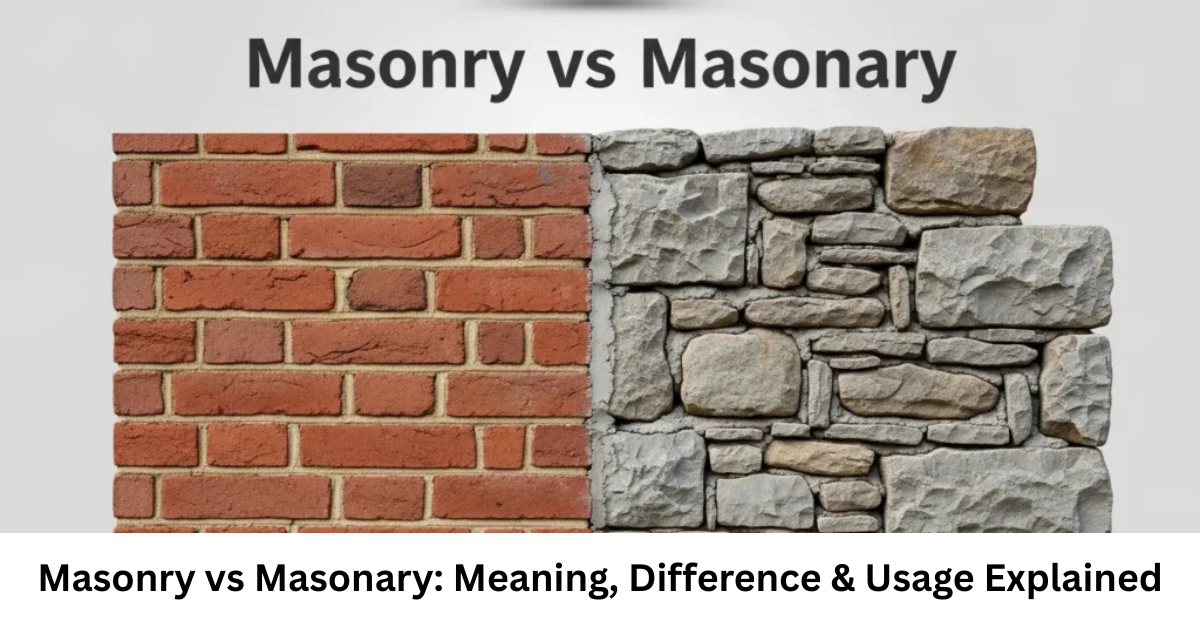
If you’ve ever typed masonry vs masonary, you’re not alone. This is one of the most commonly searched spelling confusions in construction and design topics. The correct term is masonry, but many people mistakenly write masonary.
In simple terms, masonry refers to the art and technique of building structures using materials like bricks, stones, or concrete blocks. The incorrect version, “masonary,” is just a spelling error that has become widespread online.
Let’s break it down clearly so you never mix it up again.
What is Masonry?
Masonry is a traditional building method used for thousands of years. It involves stacking and binding materials like:
- Bricks
- Stones
- Concrete blocks
- Tiles
These materials are held together using mortar (a mixture of cement, sand, and water).
Key Features of Masonry:
- Extremely durable and long-lasting
- Fire and weather resistant
- Provides strong structural stability
- Used in walls, pavements, and buildings
In construction, masonry is valued for both strength and aesthetics.
Why Do People Write “Masonary”?
The confusion between masonry vs masonary usually comes from pronunciation. Since “masonry” is pronounced quickly, many people assume there’s an “a” after the “n.”
However, linguistically, masonry comes from the word “mason,” meaning a skilled stone worker. The correct spelling does not include an extra “a.”
So, “masonary” is simply a common spelling mistake—not an alternative form.
Masonry vs Masonary: The Key Difference
Let’s make it crystal clear:
- Masonry → Correct spelling, accepted in construction and architecture
- Masonary → Incorrect spelling, commonly used by mistake
Whenever you are writing professionally, especially in architecture, engineering, or interior design, always use masonry.
This small correction makes a big difference in credibility.
Types of Masonry Work
To understand masonry better, here are its main types:
1. Brick Masonry
Uses clay bricks bonded with mortar. Common in residential buildings.
2. Stone Masonry
Uses natural stones for a strong and aesthetic finish.
3. Concrete Block Masonry
Uses hollow or solid concrete blocks for modern construction.
4. Veneer Masonry
A decorative layer applied over structural walls for appearance.
Each type plays a different role in construction depending on strength, design, and cost.
Why Masonry is Important in Construction
Masonry is not just about building walls—it’s about creating long-lasting structures.
Some major benefits include:
- High compressive strength
- Low maintenance requirements
- Energy efficiency (better insulation)
- Timeless architectural appeal
This is why masonry remains one of the most trusted construction techniques worldwide.
Common Mistakes in Spelling Masonry
Many writers accidentally use:
- masonary
- masanory
- masnory
But only one form is correct: masonry
Remembering this will help especially in academic writing, SEO content, and professional documents.
Quick Tip to Remember the Correct Spelling
Think of it this way:
“Mason” (worker) + “ry” (work/skill) = Masonry
No extra letters needed.
FAQs About Masonry vs Masonary
1. What is the correct spelling: masonry or masonary?
The correct spelling is masonry. “Masonary” is incorrect.
2. Why is masonry important in construction?
Masonry provides strength, durability, and resistance against fire and weather.
3. Is masonary a word in English?
No, “masonary” is not a valid English word. It is a common spelling mistake.
4. Where is masonry commonly used?
It is used in buildings, walls, pavements, bridges, and architectural structures.
5. What are the main materials used in masonry?
Bricks, stones, and concrete blocks are the most commonly used materials.
Conclusion
Understanding masonry vs masonary is simple once you know the correct spelling and meaning. Masonry is a vital construction technique that has shaped architecture for centuries, while “masonary” is just a frequent typing error.
Whether you’re a student, designer, or construction enthusiast, using the correct term enhances your clarity and professionalism. Keep the spelling right, and your knowledge will always stand strong—just like masonry itself.