The confusion between lisense or license is more common than you might think. Many people wonder which spelling is correct and why both versions appear in different contexts. If you’ve ever paused while writing and questioned whether it’s license or lisense, you’re not alone.
In this guide, we’ll break down the correct spelling, explain why the confusion happens, and show how the word is used in American and British English. By the end, you’ll clearly understand how to use it correctly in writing and everyday communication.
Lisense or License: What is the Correct Spelling?
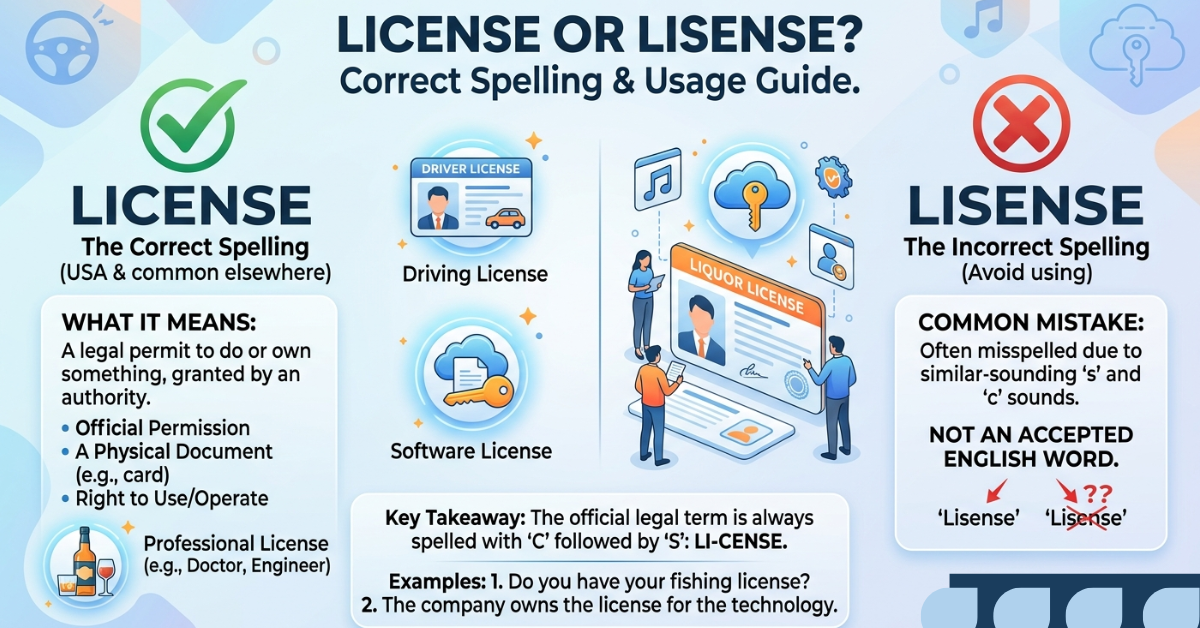
The correct spelling is license. The word lisense or license often causes confusion due to pronunciation, but only one form is accepted in standard English.
- Correct: license
- Incorrect: lisense
The spelling “lisense” is simply a common mistake and is not recognized in formal writing, dictionaries, or professional communication.
So whenever you are unsure between lisense or license, always choose license.
Why Do People Confuse Lisense or License?
The confusion between lisense or license usually comes from how the word sounds when spoken. English pronunciation often doesn’t match spelling directly, which leads to errors.
Here are some common reasons:
- The soft “c” sound in license sounds like an “s”
- Fast pronunciation can make “license” sound like “lisense”
- Influence from informal texting and social media writing
- Lack of awareness of spelling rules
Understanding these reasons can help reduce mistakes in the future.
American vs British English Usage
One of the biggest sources of confusion comes from regional differences.
American English
- License is used for both noun and verb forms
Example: He got a driver’s license.
British English
- Licence (noun) → document or permission
- License (verb) → to give permission
Example:
- He holds a driving licence. (noun)
- The government will license the company. (verb)
So, depending on where you are writing, the usage may change—but the spelling lisense is never correct in either case.
License as a Noun and Verb
To fully understand the word, it’s important to know how the word functions in grammar.
As a noun
A license refers to official permission.
- Driving license
- Business license
- Software license
As a verb
To license means to grant permission.
- The city will license new vendors.
- The authority licensed the project.
This dual usage is why many learners get confused.
Common Mistakes with Lisense or License
Many writers make small spelling errors when using the word. Here are the most frequent ones:
- Writing lisense instead of license
- Mixing British and American forms incorrectly
- Using “license” when “licence” is required in UK English noun form
- Misusing the word in formal documents
Being aware of these mistakes can significantly improve your writing accuracy.
Easy Tips to Remember the Correct Spelling
If you often struggle with the spelling, here are simple tricks:
- Remember: “license” contains ICE, like something official is “iced” or fixed
- Think of “license” as a rule or permission you see clearly
- Practice writing it in sentences regularly
- Use spell-check tools, but don’t rely on them completely
Small memory tricks like these can make a big difference.
FAQs
1. What is correct: lisense or license?
The correct spelling is license. “Lisense” is incorrect.
2. Why do people write lisense instead of license?
It’s mainly due to pronunciation and spelling confusion in English.
3. Is license American or British English?
In American English, “license” is used for both noun and verb. In British English, “licence” is the noun form.
4. Can I use lisense or license interchangeably?
No. Only license (or licence in British noun usage) is correct in formal writing.
5. What is a license in simple words?
A license is official permission to do something, like driving or running a business.
Conclusion
Understanding lisense or license is simple once you know the rule: the correct spelling is always license. The confusion usually comes from pronunciation and regional differences, but in formal writing, accuracy matters.
Whether you’re writing an essay, email, or official document, using the correct form improves clarity and professionalism. Keep practicing, and soon the right spelling will become second nature.